Casual Employment Contract Template
Casual Employment Contract Template Download
The difference between Casual and Permanent Employees can be confusing and there is no definitive legal test. The term ‘casual worker’ is not a precise legal term but rather a colloquial expression.
It is estimated that around 26% of the total workforce in Australia are casual employees. Women and young people as well as those nearing retirement are strongly represented amongst this group. The average job duration for a casual employee is just shy of three years.
Although a precise definition eludes the term ‘casual’, it is accepted that a casual is hired on an informal, uncertain and irregular basis. Bar staff or shop assistants who are never exactly sure when they will be required for work are prime examples. Casual positions are sometimes used to trial workers and permanent work is offered as a reward for good performance.
The main characteristics of casual employment are:
- No entitlement to overtime, holiday, sick or parental leave;
- Casual loadings in compensation for a lack of entitlements;
- Irregular patterns or rosters;
- Hourly pay rates;
- Irregular hours or less than full-time employees;
- No expectation of ongoing employment; and
- Series of separate contractual engagements.
In essence, a regular and systematic engagement with a reasonable expectation of continuing employment are not usually characteristic of casual employment.
There are, however, so-called ‘permanent casuals’ in the Australian labour force or workers who have ongoing and stable jobs but are treated legally as casuals. Some casuals are better categorised as ‘permanent casuals’, whose hours or rosters may vary to some degree, subject to demand, but for the most part are fairly consistent. The most common definition in awards refers to a casual as ‘engaged and paid as such’.
A distinctive feature of Casual Employment is that there is a separate contract of employment, each time the employee accepts an offer. The casual employee is given no guarantee of future employment and each contract effectively has a short fixed term. Whether or not a single contract is involved, or a series of them, the casual employment engagement is determined by the irregularity of the hours of work, any applicable award definition, the number of hours worked, and availability as and when required.
Casual employment contract

The Fair Work Act 2009 (Cth)
There is no definition of ‘a casual’ in the Fair Work Act (the Act) and employers are given a broad scope for discretion in hiring casuals, who are offered few entitlements compared to permanent employees. For this reason, awards impose a loading on the rate of a casual’s wage. Pay loadings of at least 20% on the basic rate of pay are required to be paid (s 294). The national minimum wage order must also set the casual loading for award/agreement free employees (s 294(1)(c).
Modern award minimum wages include casual loadings (s 284(3)(b)). The new ‘modern awards’ that have taken effect in 2010 have increased the loading to 25%. This is to compensate the casual for the fact he or she is not entitled to annual leave, sick leave, and severance pay if the position is terminated.
There are important distinctions between casual and permanent (including full-time and part-time) employees. The entitlements for casuals under the Fair Work Act 2009 (Cth) are as follows.
What does a casual miss out on?
If a casual is engaged by a ‘national system employer’, The National Employment Standards in the Fair Work Act (which commenced on 1 January 2010) provide that he or she is not entitled to:
- annual leave (s 86);
- paid/carer’s leave (s 95);
- notice of termination or redundancy pay (s 123(c));
- paid community service leave or paid jury service leave.
Casual employment contract template

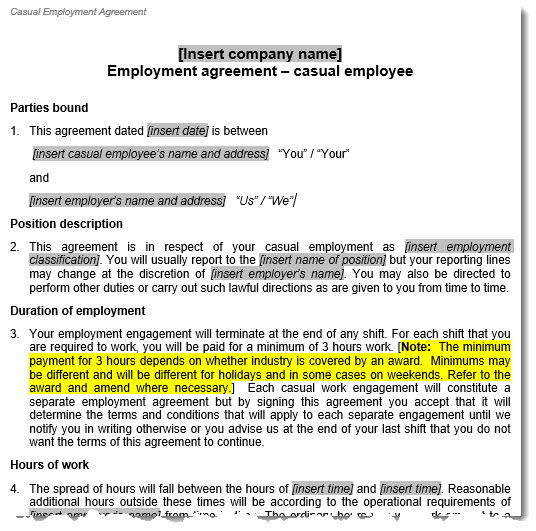
This up to date Casual Employment Contract is suitable for casual employees employed under a modern award where the standard award entitlements apply.
Save Time And Money!
Download Your Complete Employment Contract Solutions Pack Now!
These contracts are also available in a complete solutions pack containing;
-
Full time Employment Agreement - Our Full time Employment Agreement is suitable for all employees employed under a modern award where the standard award entitlements apply.
-
Casual Employment Agreement - This up to date Casual Employment Contract is suitable for casual employees employed under a modern award where the standard award entitlements apply.
-
Permanent Part-time employment Agreement - This up to date Permanent Part-Time Employment Contract is suitable for part time employees employed under a modern award where the standard award entitlements apply.Part-time employees work less hours than full-time employees and receive all the entitlements of full-time employees but on a proportional basis
-
Fixed Term Employment Agreement - This up to date Fixed Term Employment Contract is suitable for Fixed Term employees employed under a modern award where the standard award entitlements apply.
-
Individual Flexibility Agreement is an employment contract between a single employer and employee that modifies the application of a Modern Award or enterprise agreement.
-
Sole Trader Contractor Agreement and Incorporated Contractor Agreement - These Two Contractor Agreements defines the terms and conditions under which a company engages the services of a the contractor. The documents protects the company or payer and binds the contractor through the inclusion of restraint, confidentiality and intellectual property provisions.
-
Employee non-compete agreement
This agreement prohibits an employee from competing with the employer once s/he has left the employer’s service.
Each employment contract comes with a unique and comprehensive easy-to-follow users guide. The guide will walk you through the whole process to make sure you have the correct agreement which is fully compliant under the Fair Work Act.
Australian tax office Approved 100 % Tax deductable
Download Your Complete Employment Contract Solutions Pack Now!